


If you haven’t already - get the second edition of the MBP book here. Posts on MBP.co make a lot more sense if you’ve read the book!
The benefit of having a large sample size of startups leveraging the MBP is the opportunity to spot emerging patterns. One pattern that’s been increasingly common is the central role of the MLP (market leadership positioning) in PSP (potential strategic partner) conversations. The MLP is making a big comeback and we’re going to get you up to speed so you can incorporate it into your MBP game.
MLP refresher
I introduce the MLP towards the end of Chapter 6 in the MBP book, as essentially the counterweight to the TLM (two line model) in the development of the PBI (partner big idea). I posit the MLP as part of the economic layer of the PBI: The first tool is an articulation of a top-down perspective I call a Market Leadership Positioning (MLP). The MLP serves as the North Star for your economic conversation. It articulates in a high-level quantitative and qualitative way what market supremacy would bring to the PSP.
The MLP is the overall context for the big idea, it’s actually more important than its position in the book might imply. I did it (and you) a disservice by cramming it into the back of Chapter 6. The MLP plays a central role in the process, and if I ever write the third edition of the MBP, the MLP will likely be its own chapter before the chapter that dives deep into developing the big idea.
The MLP is the articulation of how the PSP will emerge as the #1 player in this new market, and how you will help them accelerate that emergence. It’s how the PSP becomes the Coke of the category, not the Pepsi, nor the RC, nor the Shasta - the Coke.
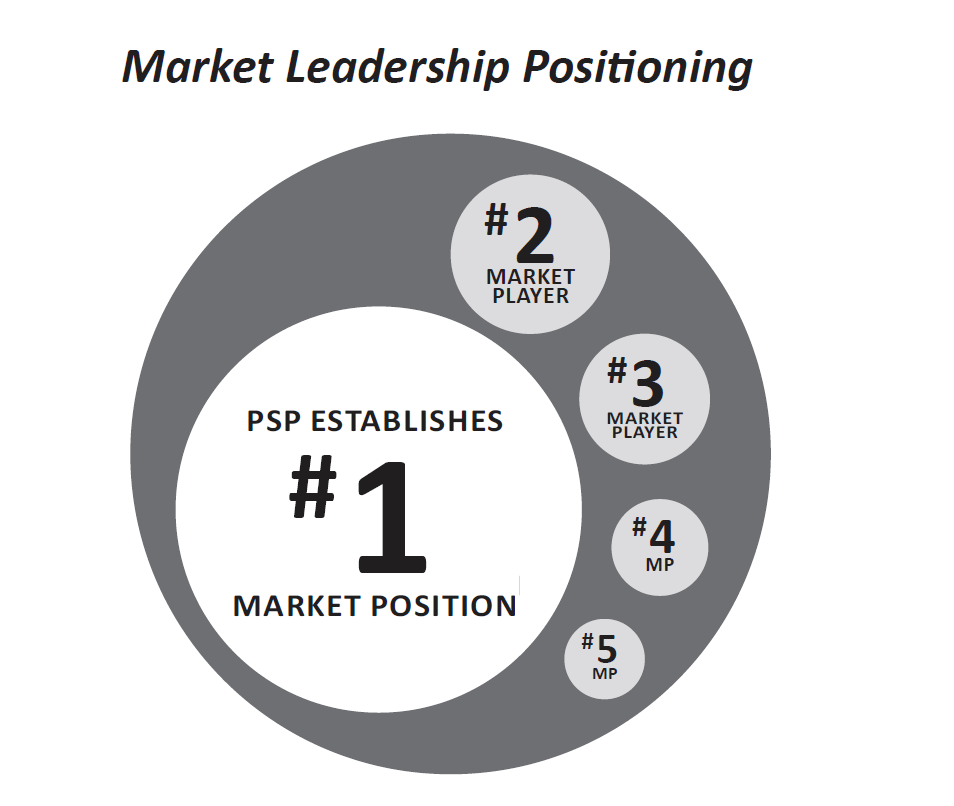
I shared a draft of this document with one of my clients and his first reaction was “the MLP is a document for winners.” It’s written with a confident voice and anticipates tremendous success.
“EIR” Elephant in room
Before we dive into the MLP, there’s one issue we have to address straightaway. I’ve been accused of an overuse of three letter acronyms, or as Dave Kellogg calls them in his piece on the MBP: The Odd Little Book All Founders Should Read “TLAs.” To be clear, there are only five TLAs in the MBP book, and one is MBP, the book itself! Which leaves four: PSP (do we really want to spell it out every time we say potential strategic partner?), PBI (partner big idea, the central concept of the book), TLM (two line model, pretty self explanatory), and MLP (barely used...until now). TLAs are efficient, I’ll add them judiciously in the future, but they do a lot of work in a small amount of space.
Positioning the positioning
The MLP will iterate and evolve as your conversation with the PSP develops, and as the PBI takes shape. What I want to do in here is give you the tools to get the MLP process started. So this article isn’t attempting to give you a comprehensive list of all the things that could eventually be in an MLP, but rather giving you the initial set of items that will help you get the MLP ball rolling.
Before diving in let’s remind ourselves of one critical reality: the MLP isn’t yours - it’s theirs. You’re writing the first draft of a document that will ultimately be owned, extended, and evangelized by the PSP. Their strategy, their leadership position, their story. You’re just the one getting it started.
This has direct design implications. You don’t want to hand them a finished painting. You want to hand them a canvas with the sketch on it — enough structure that they can see where it’s going, but also enough blank space that they feel compelled to pick up the brush and start filling in. Also, if you’re positioned as the painter, then they are instantly cast as the critic - and those are roles we absolutely want to avoid. You’re the apprentice setting up the canvas and paints so that the master can get to work! In short, a perfectly polished MLP is a conversation stopper. An MLP-in-process is a conversation starter.
Also don’t assume PSPs are good at this kind of big-picture thinking. As I note in Chapter 6 of the MBP book, more often than not they aren’t. That’s not a knock on them — large organizations optimize for execution, not for the kind of expansive strategic visioning the MLP requires. It’s your job to take the lead. That doesn’t mean charging in with TED talk energy. It means being subtly proactive. Most of my clients introduce a first MLP draft with something like: “I was thinking about our recent conversations and put a few ideas down — if you have a minute, take a look.” That’s it. No fanfare. No ask. Just a thread for them to pull.
And when you do put it in front of them — don’t wait for the horns to sound. They probably won’t. The typical response is some version of “great, thanks, we’ll review.” That’s fine. That’s actually the right response. The MLP isn’t supposed to land like a bomb. It’s supposed to land like a seed. Big thinking takes time to percolate. What you’re watching for isn’t an immediate reaction — it’s the gradual shift in the conversation that follows. When the MLP starts working, you’ll feel it: questions get sharper, more people show up to the calls, the PSP starts riffing on ideas you planted several meetings ago.
One more thing: the MLP is a living document. Not a deliverable, not a deck you send once and archive. Add to it as new information is discovered. Build in questions — actual, written questions — that invite the PSP’s team to contribute. We’ll dig into those hooks more as we get into the structure, but the principle is that every subsequent version of the MLP should incorporate their input and increase their participation.
On format: I’ve found a shared doc works better than a presentation for this purpose. Slides have a one-way energy, documents tend to be more collaborative. But I’m not dogmatic about it. Do what fits the relationship and context.
The work the MLP does
The MLP is going to be doing a lot of work. It’s going to frame the strategic context of the PBI. It’s also going to be the internal “selling” tool for PSP stakeholders. The MLP travels; it gets shared in rooms you’re not in, with executives you haven’t met yet.
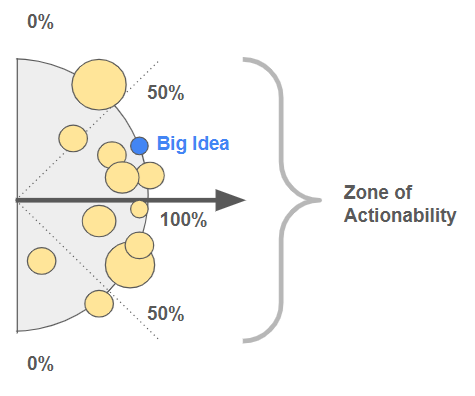
Always remember that you’re an entrant in a competition of ideas. As I discussed in the MBP.co post on urgency, you are trying to outcompete any number of other ideas to make this one the most critical and most urgent. Pulling a couple graphs from that piece. With the blue dot representing the PBI you’re building with the PSP, you’re trying to go from this :
To this:
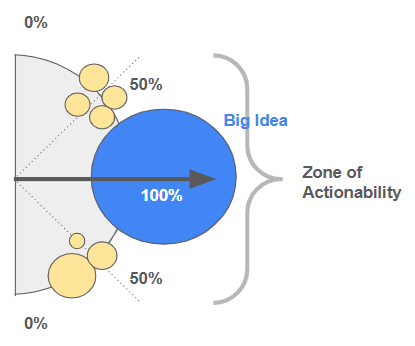
(Note: these graphs are explained in the urgency post - but the %’s are the amount of alignment the Big Idea has with the PSP’s direction and priorities.)
You want the PBI to be so powerful in the PSP executive team mind’s eye that it blots out the light on all other ideas! By extension, a well constructed MLP makes everyone involved with it sound smarter. You’ll sound smarter as you’re speaking from this elevated conceptual position. Your sponsor at the PSP will sound smarter with their firm grip on this dynamic situation. The PSP’s executives will sound smarter to their board with with this well considered strategy.
The MLP sets the stage for the PBI
In the MBP.co post New Gap Chapter 5.5: PSP liftoff I discussed the process for initiating PSP conversations. I’m not going to rehash that post here, but read that post alongside this one. Together they are the conceptual and practical framework for initiating PSP conversations. It’s essentially the prequal to this article.
Market forces
As I highlight in the gap chapter post, MLP thinking starts with articulating the driving market forces creating the opportunity space for this new idea. At any given time there are innumerable forces at work in the market, some of those forces are directly relevant to creating the opportunity space for the PBI. It’s essential that you describe and refine those forces, those forces are what create the gravitational pull for the PBI. Take your first shot at defining them, then discuss them with the PSP, then update. It shouldn’t take dozens of iterations to get to a pretty clear set of driving forces - you may tweak them as you go - but the core of them are probably pretty easily definable. Make a list. Keep it clear and simple. If they can’t be listed on a napkin then they’re too vague to be useful.
Opportunity space
After market forces, provide a summary of the opportunity layer of the PBI. What are the size of long and near-term markets? It’s OK to be bold (in fact it’s important to be so!). Make it clear and compelling. Describe how the layers of the opportunity and the key gaps that will emerge as these markets mature, gaps that in combination the PSP and you will be positioned to fill.
Demand profile
Now link the market forces and larger opportunity profile to identifiable needs at target customers. Where is demand? If there’s a giant long-run opportunity there should be at minimum glimmers of related demand at current potential customers. Show how that near-term demand is actually the signal for identifying the longer range market opportunities. Get creative, clients of mine have used surveys and phone interviews to create demand profiles in advance of actually having commercially viable products to serve the market. Frame the scope of these addressable customer needs and make the opportunity seem tangible and real. Where appropriate you can incorporate examples (even if limited in nature) of where your startup has met the relevant customer needs that point to the broader market opportunity. Along these lines, some of my clients discuss concepts they are developing in MLPs with their customers to help refine their thinking around long-term demand - their best customers are often incredibly forward thinking.
Right to win (PSP assets in position)
This is where you’re going to help the PSP help themselves. The motivational speech portion of the MLP. What are the assets (writ large) the PSP has in position that gives them the edge in establishing the leadership position in this market. Think broadly, this could include brand, customer base, existing offerings, institutional knowledge, technology, ... But remember, you’re only providing the starter list, the PSP will expand and refine this section. What you want to tee up is their realization that they have the asymmetrical leverage to win in this category. Link their assets together in a way that illustrates their full, combined, strength.
Ability to accelerate
Now you. How does your startup supercharge this strategy. How will your expertise, technology, experience boost the PSP’s efforts and enable them to leapfrog the competition? How do your capabilities interoperate with their assets? Connect your strengths to their strategic position. Provide the meta narrative about the emerging needs you’ve set out to address, and why those needs are directly relevant to the PBI. Then link all of this back to the broad shifts in the market. You are clearly way ahead of these trends. You’re the team that understands them the best. The PSP has the right the win, and you’re the accelerant they need to do it.
Relative to competition
This is the “L” in MLP. They can’t be the leader without others who aren’t. Provide an initial perspective on likely competitors in this arena and highlight how in combination the PSP’s assets and your ability to accelerate their strategy leapfrogs the others. This doesn’t have to be an exhaustive competitive analysis, but it should represent the big names and few easy to digest points of competitive advantage.
–Infusing the risk inversion–
At this point something very powerful should be happening.
